Main Concept
Neural Networks are computing systems loosely inspired by how the biological brain works. The brain processes information through neurons connected by synapses — neural networks do something analogous using nodes connected in layers.
Structure
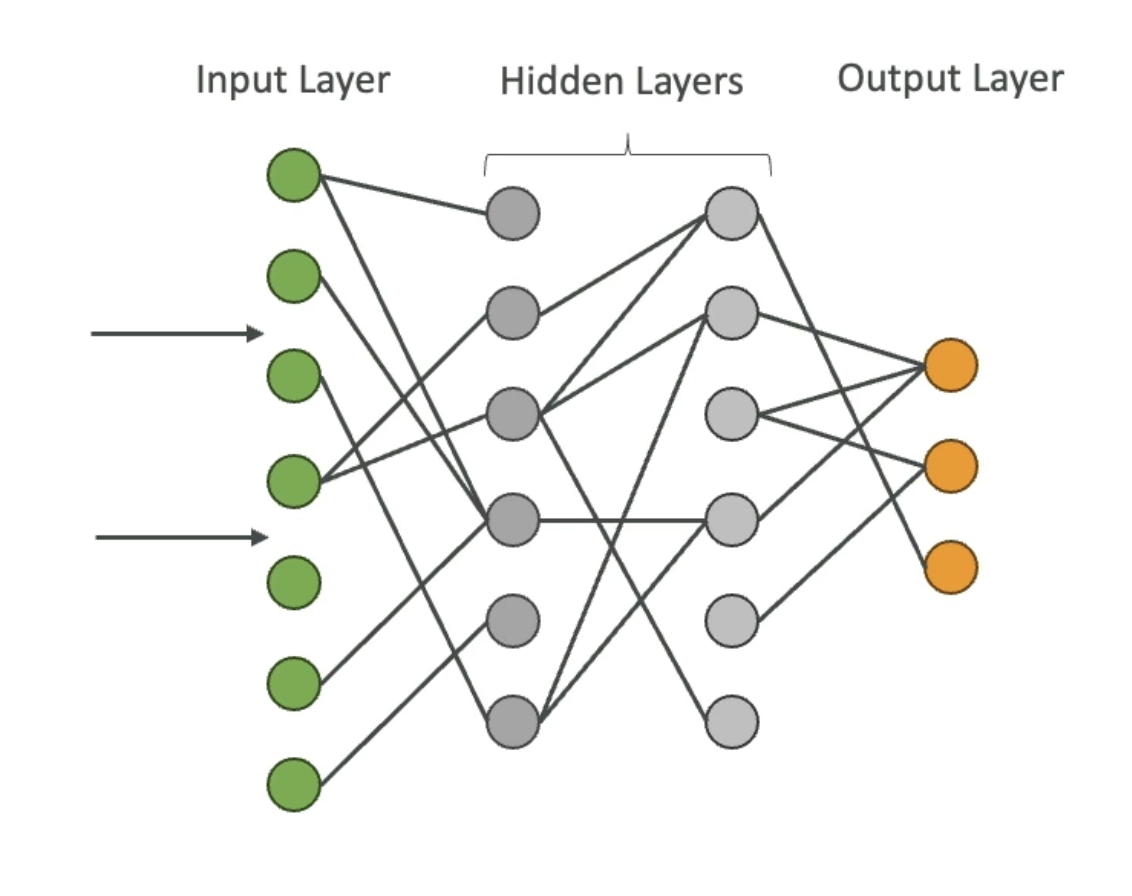
Every neural network has at least three types of layers:
- Input layer — receives the raw data (pixels, text tokens, numbers, etc.)
- Hidden layers — intermediate layers where the actual pattern learning happens. The more hidden layers, the “deeper” the network — hence Deep Learning.
- Output layer — produces the final result (a category, a number, a word, etc.)
How Learning Works (without the math)
Think of nodes as decision points that pass information forward — or don’t, depending on how strong their connection is. When the network sees a lot of data, it gradually adjusts the strength of the connections between nodes until it gets better at producing the right output.
That’s really it at the conceptual level: lots of data → lots of adjustments → connections that reflect patterns in the data.
In practice, a neural network may have billions of nodes. The math and parameter tuning behind this process is well beyond the scope of this course and the AIF-C01 exam.
Deep Learning Example
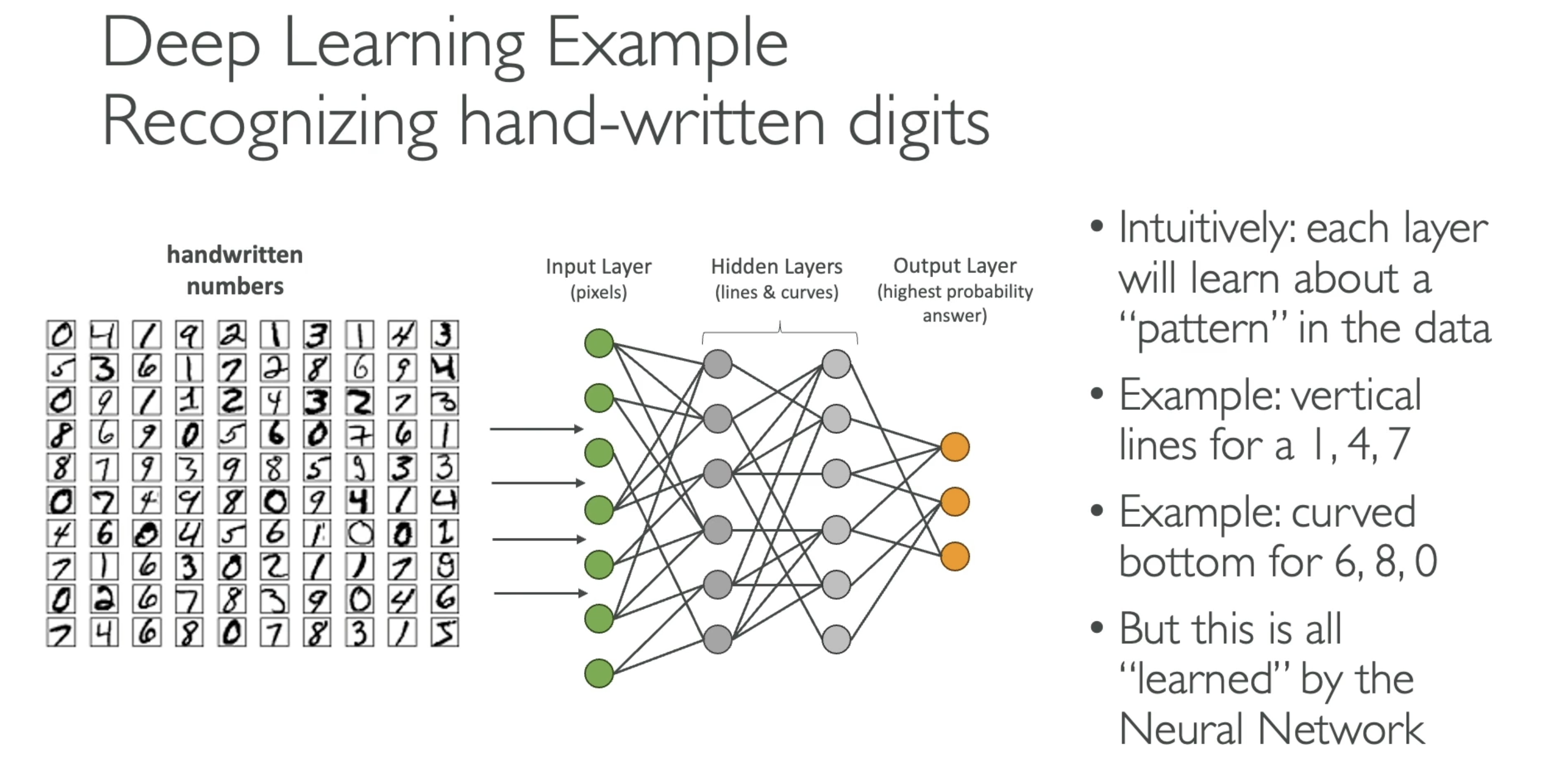
A classic example: recognizing handwritten digits. The input layer receives pixel values from an image. Hidden layers detect increasingly abstract features — edges, curves, shapes. The output layer produces a prediction: “this is a 7.”
AIF-C01 Exam Relevance
The exam won’t test the math. What you should know:
- Neural networks are the building blocks of Deep Learning
- More layers = deeper network = more capable, but also more data and compute required
- Foundation models (LLMs) are neural networks with a specific architecture called the Transformer
- Training neural networks at scale requires GPUs — that’s why specialized hardware like AWS Trainium exists