Main Concept
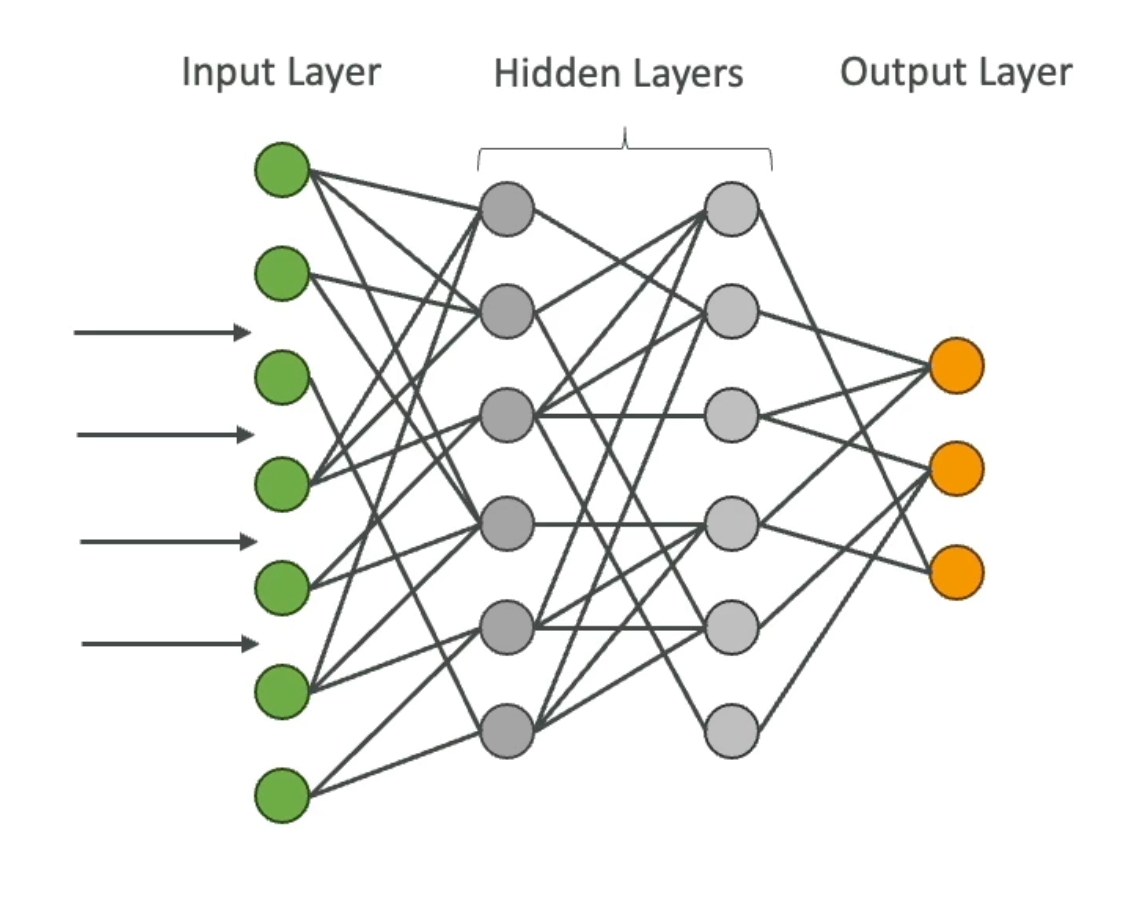
Deep Learning is an advanced form of Machine Learning that uses multiple layers of Neural Networks to process data. It’s called “deep” because of the depth of those layers — each one learns increasingly abstract representations of the input. The architecture loosely emulates how neurons and synapses work in the brain, though the analogy only goes so far.
Context
Deep Learning is the foundation of most modern Generative AI models. Before DL, ML required significant manual feature engineering — humans had to decide what characteristics to extract from data. Deep Learning removes that burden by learning features automatically from raw input.
Key Aspects
- Requires large amounts of data — typically millions of examples to train effectively. Less data usually means worse performance compared to traditional ML.
- Computationally expensive — training many layers of neural networks demands serious compute. GPUs (and increasingly specialized chips like AWS Trainium) are far more efficient than CPUs for this type of parallel workload.
- Automatic feature extraction — unlike traditional ML, DL models learn which features matter directly from raw data (pixels, characters, audio samples).
- Better for complex unstructured data — images, audio, video, and text are where DL excels. For structured/tabular data, traditional ML often still wins.
Relationship to the AI Stack
Artificial Intelligence
  └── Machine Learning
        └── Deep Learning
              └── Generative AI (LLMs, Diffusion Models, etc.)
Deep Learning is the layer that made modern GenAI possible. Foundation models like Claude, GPT, and Stable Diffusion are all built on deep neural network architectures.
Examples
Computer Vision — image classification, object detection, and image segmentation all rely on deep learning (specifically Convolutional Neural Networks, or CNNs).
Natural Language Processing — text classification, sentiment analysis, machine translation, and language generation are powered by deep learning architectures, most notably the Transformer.
AIF-C01 Exam Relevance
Exam tip: Know where Deep Learning sits in the AI hierarchy (subset of ML, foundation of GenAI). The exam won’t go deep into architecture details, but you should understand why DL enabled the GenAI revolution: automatic feature learning at scale, powered by GPUs and massive datasets.
Key associations for the exam:
- DL → requires GPUs (AWS: EC2 P/G instances, AWS Trainium for training, AWS Inferentia for inference)
- DL → foundation of LLMs and foundation models
- DL → powers Computer Vision and NLP use cases
Related Notes
- Artificial Intelligence (AI)
- Machine Learning (ML)
- Neural Networks
- Generative AI (GenAI)
- Computer Vision
- Natural Language Processing