Main Concept
Self-Supervised Learning is a training technique where the model generates its own labels automatically from the structure of the data itself — no human annotation required. The labels are not invented by the model; they are extracted directly from the raw data.
Key distinction from Semi-Supervised Learning: in semi-supervised, a human labels at least some data to start. In self-supervised, zero human labels are needed — the data labels itself.
How It Works
The model is trained on pretext tasks — simple artificial tasks where the answer (label) is already hidden inside the data:
- Next-word prediction: given “Amazon Web Services, Inc. (AWS) is a subsidiary of…”, predict the next word → label is “Services”, “computing”, “companies”, etc.
- Masked word prediction: hide a word and ask the model to fill in the blank
- Image reconstruction: hide 75% of an image and ask the model to reconstruct it
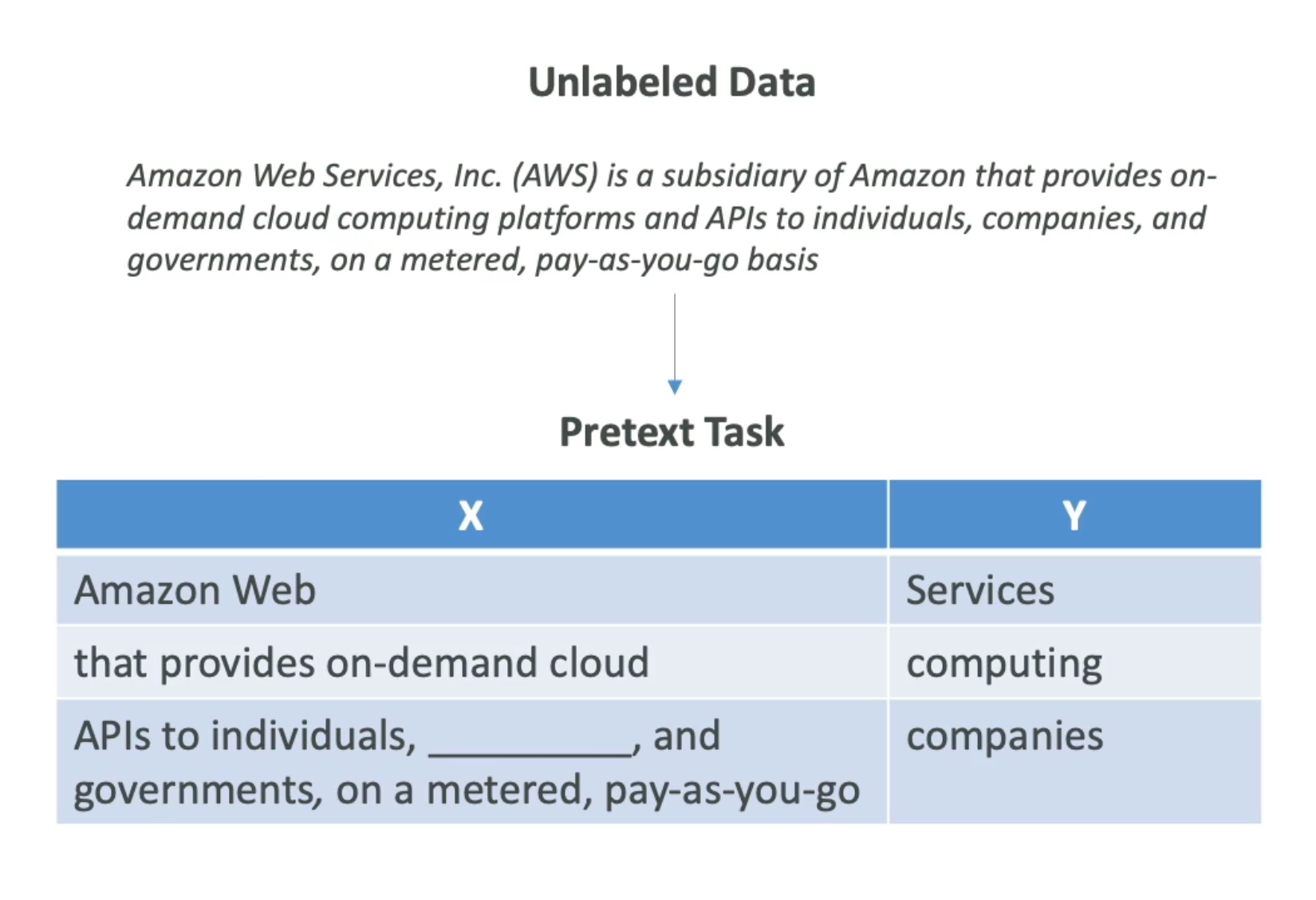
The pretext tasks are not useful in themselves — their purpose is to force the model to learn the underlying structure and patterns of the data (grammar rules, word meaning, relationships between concepts). This is directly related to how Embeddings are created.
Pretext Task → Downstream Task
Unlabeled Data
      ↓
Pretext Task (model learns structure)
      ↓
Pre-trained model with rich internal representations
      ↓
Downstream Task (the actual useful task: translation, classification, Q&A...)
Once pre-trained via self-supervised learning, the model can be fine-tuned for specific downstream tasks with very little additional labeled data.
Key Aspects
- Labels are derived automatically from the data — not invented or hallucinated by the model
- Enables training on massive unlabeled datasets (internet-scale text, images)
- The model learns to predict any part of the input from another part: past → future, visible → masked, partial → complete
- Foundation of modern large language models
Context — Why It Matters for the Exam
This is the technique behind GPT (predicts the next token) and BERT (predicts masked tokens). Understanding self-supervised learning explains how foundation models acquire general knowledge before any fine-tuning or specialization.
Applications
- NLP — language models (GPT, BERT, Claude)
- Computer Vision — image models trained on unlabeled images
- Multimodal — models like CLIP that learn relationships between text and images
Related Concepts
- Semi-Supervised Learning
- Supervised Learning
- Unsupervised Learning
- Embeddings
- Deep Learning (DL)
- Machine Learning (ML)
- Foundation Model
Exam Domain (AIF-C01)
Domain 1 — Fundamentals of AI and ML
- Task Statement 1.1: Types of ML — self-supervised learning as the mechanism behind foundation models and LLMs.
Links
References