Main Concept
Generative AI is a subset of Deep Learning used to generate new content — text, images, code, audio, video, and more — that is similar in nature to the data it was trained on. Unlike traditional ML models that classify or predict, generative models create.
Where It Sits in the AI Stack
Artificial Intelligence
  └── Machine Learning
        └── Deep Learning
              └── Generative AI
How It Works (Conceptually)
-
Generative AI uses a Generative Model, which is typically a large Foundation Model backed by a deep neural network. These models are trained on massive amounts of data and learn the underlying patterns and structure of that data well enough to generate new, original examples.
-
They are multi-purpose — a single foundation model can handle many different tasks (answer questions, summarize, translate, write code) without being retrained for each one. They can also be fine-tuned on more specific data to better fit a particular use case.
Basic Example
You train a generative model with a large dataset of dog photos and a large dataset of cartoon images. The model learns what makes something a dog and what makes something look like a cartoon. After training, it can generate a completely new image — one it has never seen — of a dog drawn in cartoon style.
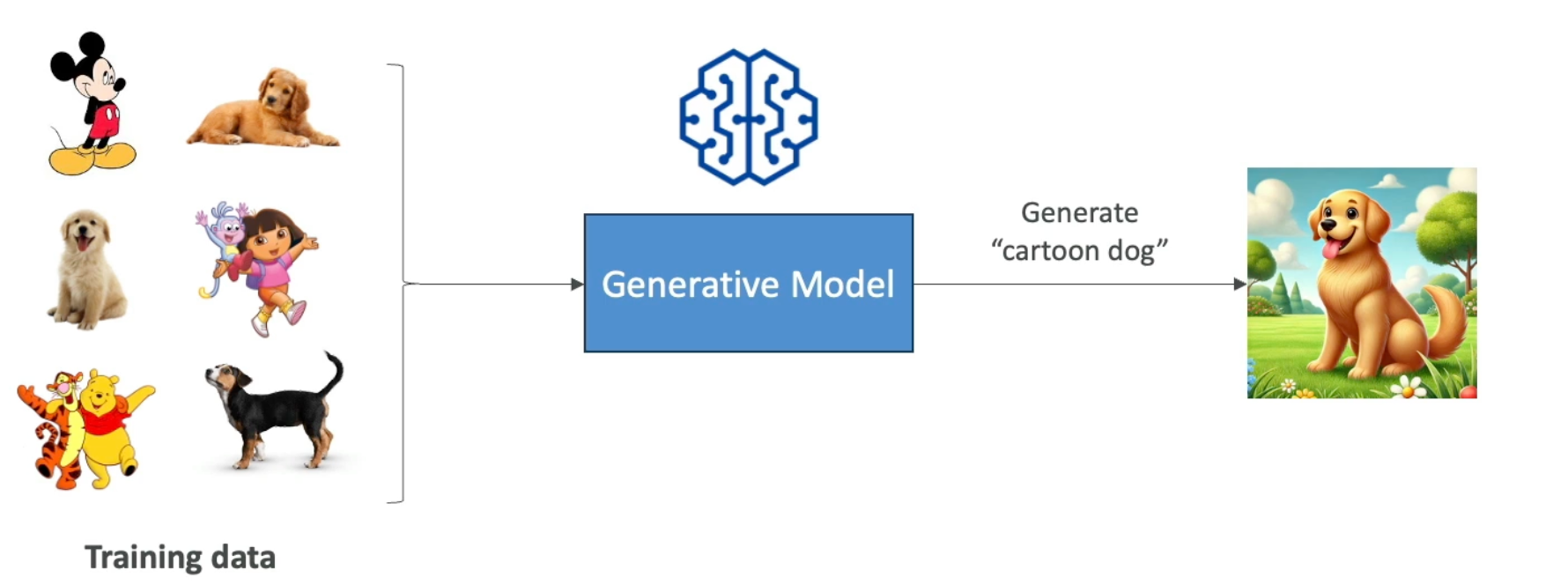
What GenAI Can Generate
| Modality | Examples |
|---|---|
| Text | Conversations, summaries, translations, emails |
| Code | Functions, scripts, Infrastructure as Code |
| Images | Illustrations, product visuals, art |
| Audio | Music, voice synthesis, sound effects |
| Video | Clips, animations |
| Embeddings | Vector representations of data for search and retrieval |
Advantages (AIF-C01)
- Adaptability — one model can handle many tasks
- Responsiveness — generates outputs in natural language, accessible to non-technical users
- Simplicity — no need to build task-specific models from scratch
Limitations and Risks (AIF-C01)
- Hallucinations — the model generates plausible-sounding but incorrect information
- Nondeterminism — the same input can produce different outputs
- Interpretability — hard to explain why the model produced a given output
- Bias — reflects biases present in the training data
- Not always appropriate — when you need a guaranteed specific outcome (not a prediction), traditional rule-based or deterministic systems may be better
AWS GenAI Offerings
- Amazon Bedrock — managed service to build GenAI apps using foundation models
- Amazon SageMaker — platform for training and deploying ML/GenAI models
- Amazon Q — family of AI assistants embedded across AWS services
- PartyRock — no-code GenAI playground built on Bedrock
- AWS ML Computing Infrastructure — Trainium (training), Inferentia (inference)