Main Concept
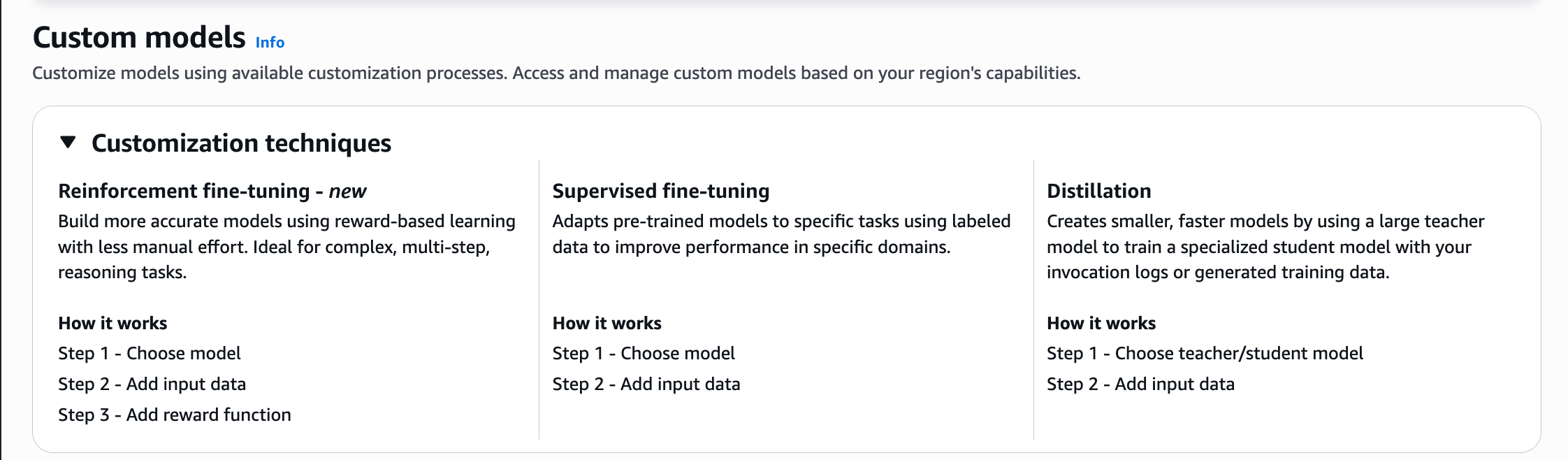
Amazon Bedrock offers three ways to customize a model. Strictly speaking, only the first two are forms of fine-tuning (this is where it gets confusing!):
- Reinforcement fine-tuning
- Supervision fine-tuning
- Distillation
IMPORTANT
Even though Bedrock shows Distillation as a Customization technique, strictly speaking Distillation is not a Customization method but a separate technique.
Reinforcement fine-tuning:
It works with a reward-based learning, it requires less manual effort. Ideal for complex, multi-step, reasoning tasks.
Supervision fine-tuning:
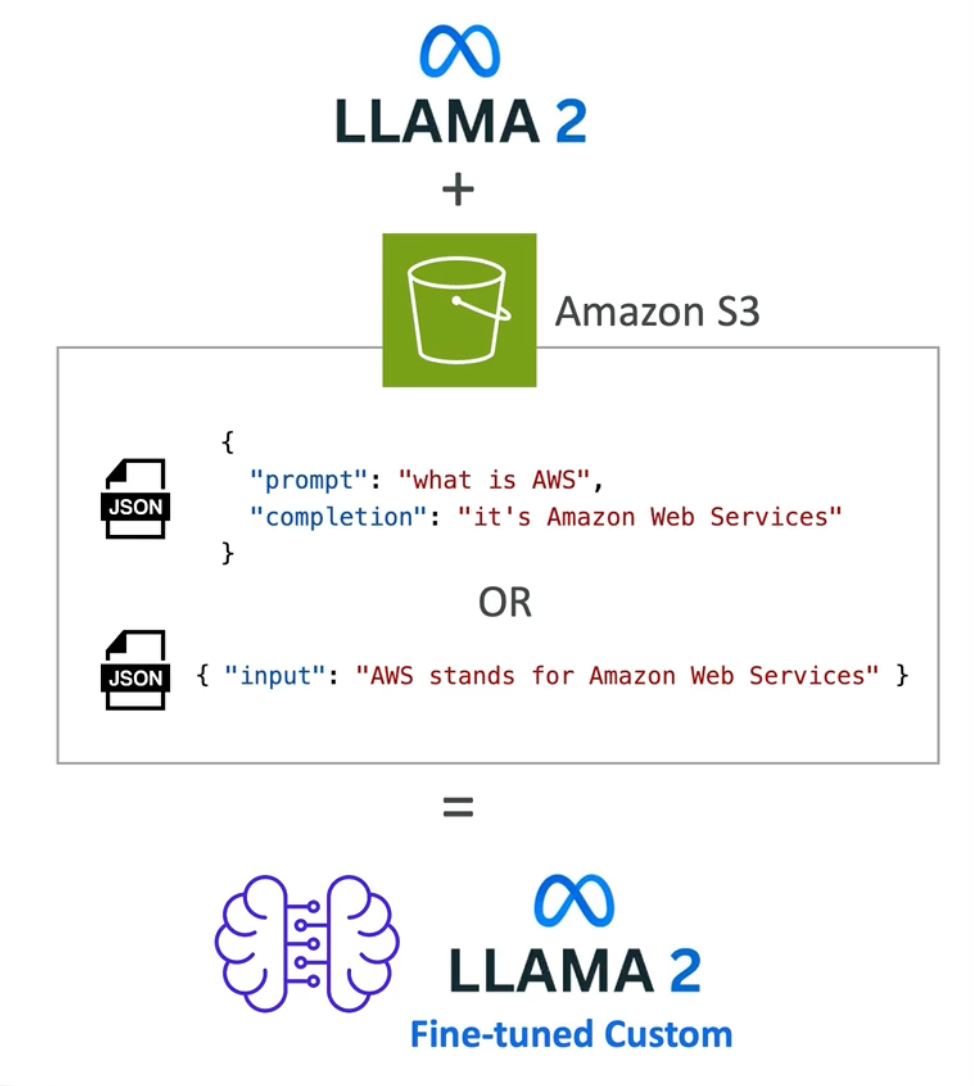
Adapts a pre-trained model to specific tasks using labeled data to improve performance in specific domain. Input and output data is stored in Amazon S3.
Distillation:
It requires a teacher model to train the specialized (student) model. it creaste a smaller and faster model .
Key Points
- Amazon Bedrock allows customization of certain models by creating a copy of a foundation model and adapting it with your own data.
- This is made by changing the weights of a base foundation model.
- In order to be able to customize a model, the training data must adhere to a specific format
- The training data must be stores in Amazon S3
- Running a custom model is more expensive in Amazon Bedrock, you have different options:
- Option 1: Run the custom model “on-demand” (price per token)
- Option 2: Puchase provisioned throughput (billed per month)
NOTE
Not all the models can be customized in Amazon Bedrock
Graphical Example
IMPORTANT
When you customize a model using fine-tuning or continued pre-training, Amazon Bedrock makes a separate copy of the base Foundation Model to create a private model
Related Concepts
- Model Customization
- Model Fine-Tuning
- Supervised Fine-Tuning
- Reinforcement Fine-Tuning
- Model Distillation