Main Concept
Supervised fine-tuning (SFT) is the process of taking a pre-trained foundation model and further training it on a smaller, specialized dataset with labeled examples to adapt it to a specific task or domain.
Key Distinction: Supervised Fine-Tuning vs. Supervised Learning
These are different concepts at different levels:
| Supervised Learning | Supervised Fine-Tuning | |
|---|---|---|
| What it is | A learning paradigm (the general approach) | A specific technique for adapting models |
| Starting point | Train from scratch on labeled data | Start with a pre-trained model, then adapt it |
| Data requirement | Full dataset labeled from the beginning | Smaller task-specific labeled dataset |
| Use case | Train any model (SVM, neural net, etc.) | Improve a foundation model for a specific task |
| Example | Train SVM from scratch on spam/ham emails | Fine-tune GPT-4 on banking customer service queries |
In short: Supervised Learning is the principle (learn from labeled examples). Supervised Fine-Tuning is the application (use that principle to adapt a pre-trained model).
Context
Supervised fine-tuning allows you to leverage an existing well-trained foundation model and adapt it to a specialized field or behavior. This is very practical for business and industry because it requires less data and compute than training from scratch, while still delivering domain-specific performance.
Key Aspects
- Pre-trained starting point — you’re not training from scratch; you’re adapting a model that already understands language, reasoning, etc.
- Task-specific labeled data — input-output pairs focused on your use case, e.g.:
- More efficient than training from scratch — requires less computational power and less data because the foundation model already has broad knowledge
- Requires domain expertise — you need to curate high-quality labeled examples and understand your domain well enough to recognize good outputs
- Full pipeline — prepare data → fine-tune → evaluate → iterate
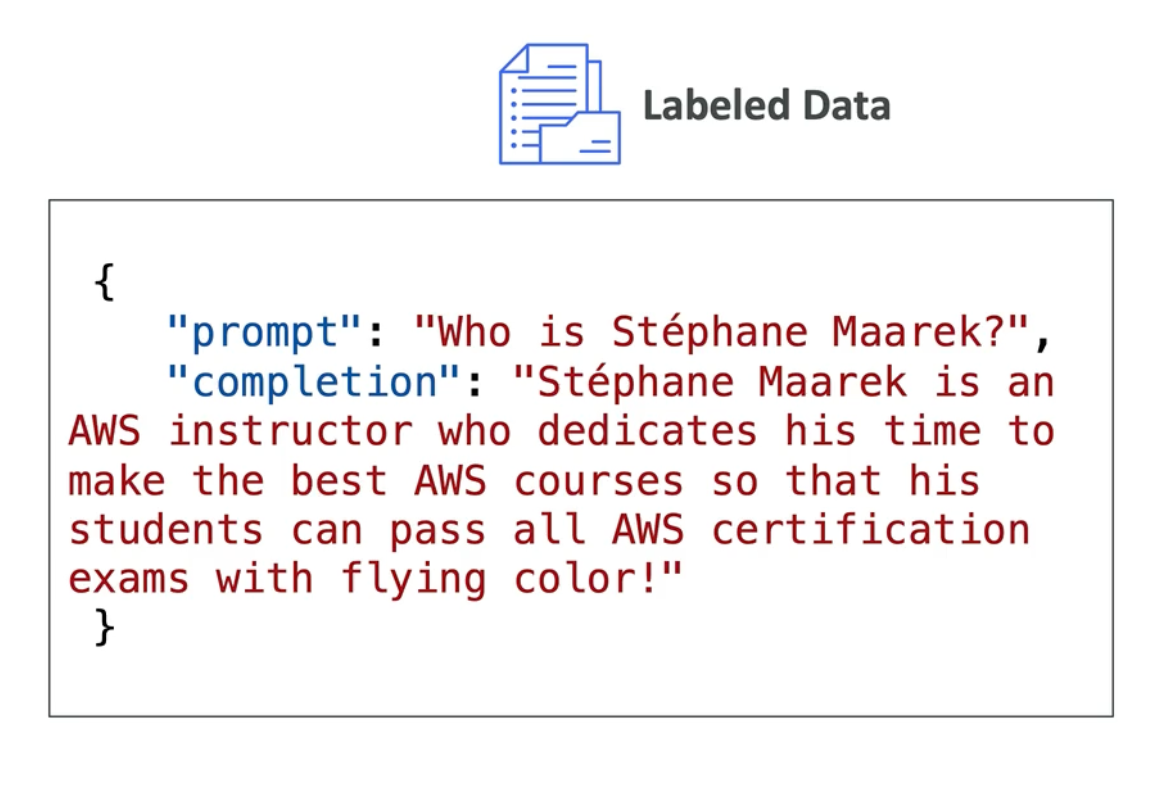
Why Fine-Tuning vs. Training from Scratch?
| Approach | Data needed | Compute | Time | When to use |
|---|---|---|---|---|
| Train from scratch | Massive (millions) | Extreme (GPUs/TPUs for weeks) | Months | Only if you have unlimited resources and unique requirements |
| Fine-tune foundation model | Smaller (hundreds-thousands) | Moderate (hours/days on GPU) | Days/weeks | Most practical scenarios |
| Prompt engineering only | None | Low (API calls) | Minutes | When the base model already works well enough |
Applications
- Customer service
- Health
- Legal services
- Banking
- etc.
Examples
Example 1: Guatemalan Banking Chatbot
Without Fine-tuning:
User: "How much does a SINPE transfer cost?"
Generic Titan: "I don't have specific information about SINPE transfers. Could you clarify what SINPE is?"
❌ Doesn't know regional payment systems
With Fine-tuning:
Training data includes 1,000+ examples of Guatemala banking queries

User: "How much does a SINPE transfer cost?"
Fine-tuned Titan: "SINPE transfers in Guatemala cost Q5.00 for amounts up to Q5,000 and Q15.00 for larger amounts. Processing time is 1-2 hours on business days.
✅ Knows regional systems, pricing, local context
AIF-C01 Exam Relevance
The exam tests understanding of when to fine-tune vs. other approaches:
- Fine-tune — you have domain-specific labeled data and need task-specific behavior
- Prompt engineering — the base model works but needs instruction/format guidance
- RAG — you need access to external knowledge without retraining
- Train from scratch — extremely rare; only when you have unique data and unlimited resources
Exam tip: A question asking “how do you adapt a foundation model to your business domain?” → answer is Supervised Fine-Tuning (if you have labeled examples) or RAG (if you need external knowledge without retraining).
Related Concepts
- Machine Learning (ML) — the broader paradigm that includes supervised learning
- Model Fine-Tuning — broader concept covering supervised + unsupervised fine-tuning
- Reinforcement Fine-Tuning — different fine-tuning approach using rewards
- Retrieval-Augmented Generation (RAG) — alternative to fine-tuning when you need external knowledge
- Foundation Model — what you’re fine-tuning