Main Concept
Association Rule Learning is an Unsupervised Learning technique used to discover relationships between variables in large datasets — specifically, which items or events tend to occur together.
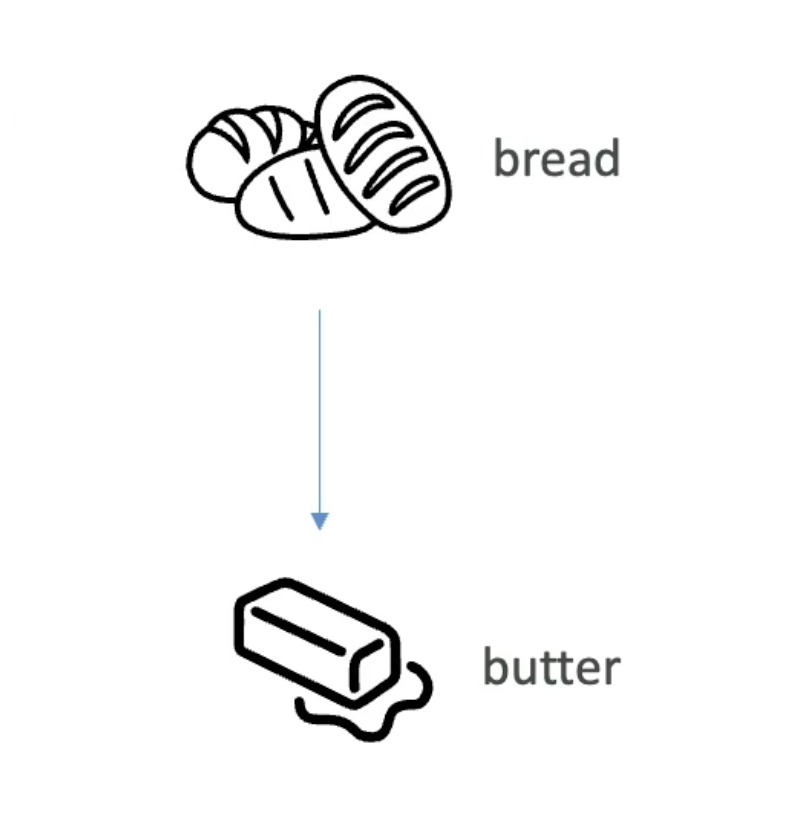
“Customers who buy bread are very likely to also buy butter.”
How It Works
- Analyze transaction records to find co-occurrence patterns
- Identify rules of the form: if X → then Y
- Rank rules by frequency and confidence
- Use those rules to make decisions (product placement, promotions, recommendations)
Technique: Apriori algorithm
Example — Market Basket Analysis
Scenario: A supermarket wants to understand which products are frequently bought together.
Data: Transaction records from customer purchases.
Goal: Identify associations between products to optimize product placement and promotions.
| Rule | Insight |
|---|---|
| bread → butter | Customers who buy bread very likely also buy butter |
| beer → chips | Often purchased together on weekends |
| baby wipes → baby shampoo | Co-purchased by new parents |
Outcome: The supermarket places associated products next to each other on shelves and runs bundled promotions — boosting sales.
Use Cases
- Retail — product placement and bundled promotions (Market Basket Analysis)
- E-commerce — “Customers who bought X also bought Y” recommendations
- Healthcare — identifying symptoms or conditions that frequently co-occur
- Streaming — pairing content that users tend to watch together
Key Aspects
- Focuses on co-occurrence, not causality — bread doesn’t cause someone to buy butter, they just tend to happen together
- Works on unlabeled transaction data — no need to pre-define groups or outcomes
- Outputs are human-interpretable rules, making results easy to act on
Related Concepts
Exam Domain (AIF-C01)
Domain 1 — Fundamentals of AI and ML
- Task Statement 1.1: Basic AI/ML concepts — association rule learning is one of the core unsupervised learning techniques.
Links
References